Why Clubs Rely on Small, Shared Jobs
Small shared jobs keep club sessions welcoming and organized; learn how clear owners, simple handovers, and a season-long rhythm make volunteering manageable.
The last players leave the court, but a few small jobs remain: return the loan rackets, stack the cones, and check that the door is secured. In an amateur sports club, these recurring tasks are part of how sessions happen. Small shared jobs work best when everyone understands who owns each one and when it needs attention.
“Shared” need not mean that every member is responsible for every task. That can leave people unsure whether anyone has acted. A clearer arrangement gives each job a named owner, while keeping the workload modest and making it easy for another person to cover an absence.
What counts as a small shared job?
These are repeatable tasks that support club activity without requiring a full committee role. They may happen before a session, during it, or as the group leaves. Their value is often easy to miss until they are forgotten: equipment is unavailable, a new participant cannot find the right group, or a venue is left untidy.
At a community badminton club, recurring jobs might include bringing out shuttlecocks, checking the sign-in sheet, welcoming someone who is new to the session, and putting away borrowed equipment. At a running club, the equivalent could be setting out route cards, greeting the group at the meeting point, or checking that the planned route is communicated before departure.
The task should be small enough to describe in a sentence and finish as part of an ordinary club visit. If it routinely expands into lengthy coordination, specialist decisions, or responsibility for other people’s safety, it may need a different role and a proper conversation about expectations.
Why does clear ownership matter more than asking everyone?
A general request such as “someone should put out the bibs” leaves the decision until the moment the bibs are needed. Several people may assume another person has handled it, or one conscientious member may quietly take on the job every time. Neither arrangement makes the work visible or predictable.
Ownership gives a task a default person, not a permanent claim over that person’s time. The owner knows when the job is due, what “done” means, and whom to tell if they cannot attend. Others can still offer help or cover, but the responsibility does not disappear into a group chat or a vague expectation.
That distinction also makes asking for support easier. “Could you cover the equipment box this Thursday?” is specific and limited; “Can everyone do more?” is hard to answer because nobody knows what action is wanted.
How can a club set a workable rhythm across a season?
A season gives a club a natural period for assigning, reviewing, and rotating small jobs. The aim is not to build a complicated volunteer system. It is to make each recurring task visible, give it an owner, and notice when the arrangement no longer fits attendance or the activity.
- At the season’s start: List only the jobs that regularly need doing. For each one, write when it happens, what completion looks like, and where any needed materials are kept.
- Before the first few sessions: Ask for volunteers for particular jobs rather than asking for a general commitment to help. Make the expected effort clear, including whether the job happens before or after play.
- At each session: The owner handles the task or arranges cover. If it is completed, a brief tick on a shared club note or a verbal handover can prevent uncertainty without creating paperwork for its own sake.
- At a mid-season check-in: Ask whether the task still happens at the right time and whether its owner can manage it. Change the arrangement if attendance, equipment, or venue routines have shifted.
- At the season’s end: Invite the next owner to take over with a short explanation of the task, its location, and any recurring snag. Thank the outgoing volunteer and remove jobs the club no longer needs.
Keep the record proportionate. A noticeboard, a shared club document, or a short message in the members’ group can work; the useful choice is the one people can find when they need it. A detailed manual for a task that takes a moment is usually more effort than it saves.
What should a useful handover include?
A handover should answer practical questions, not preserve every detail of the previous owner’s routine. Include the task’s timing, the materials or access needed, the expected finish, and the person to contact if something is missing. If there is a recurring exception, such as a different setup on match days, mention it plainly.
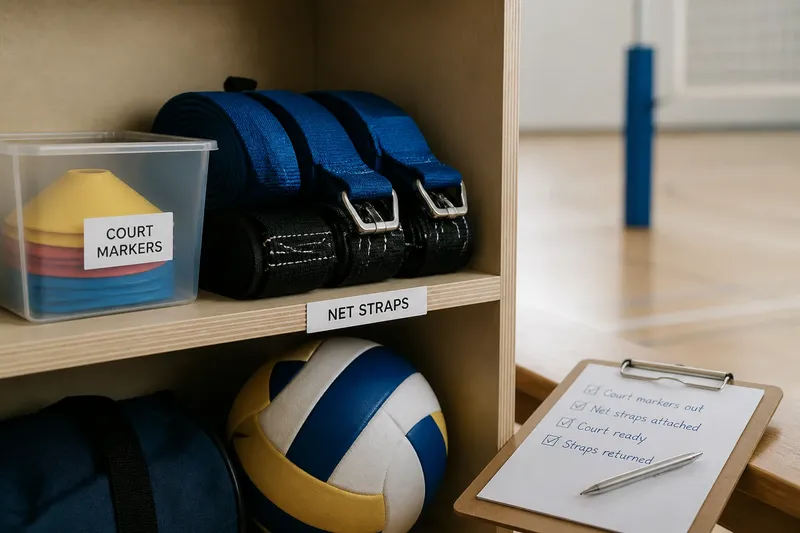
Say you play in a fictional community volleyball club where one member usually brings out the net straps and court markers. The club asks a new volunteer to cover the job on a particular evening, points out the labeled equipment shelf, and agrees that the court is ready when the markers are in place and the straps are returned afterward; the expected result is that the cover can complete the task without guessing or interrupting play to ask where things belong.
That kind of handover protects the task from being tied to one person’s memory. It also gives a volunteer a reasonable chance to decide whether the responsibility fits their schedule before agreeing to take it on.
How can rotation stay fair without becoming a burden?
Fairness does not require every member to do the same job or volunteer for the same amount of time. People differ in availability, confidence, transport, and the kind of help they can comfortably offer. A club can make a range of modest tasks available and let members choose among them, while being clear that some work still needs an owner.
Rotation can be useful for jobs that are easy to learn and do not depend on special access or experience. A welcome table or a simple equipment return may suit a changing roster. A task that relies on venue access or detailed knowledge may be more reliable with one regular owner and a named backup.
Avoid treating a rotation list as proof that the load is fair. If the same few people keep covering missed turns, the schedule may look balanced while the actual work is not. Check in directly, adjust the roster, and make it acceptable to decline or ask for a different task.
What questions do members often ask about club jobs?
What if the task owner cannot attend?
The owner should contact the named backup or club coordinator as early as practical, so the group can arrange cover. If there is no backup, the club should decide whether another member can take the task or whether that session can proceed without it.
Should new members be expected to volunteer?
A club can explain the small jobs that help sessions run, but participation should be an invitation with a clear description rather than an unstated condition. Someone who is still learning how the club works may need time before taking on a recurring responsibility.
What if nobody wants a particular job?
Check whether the task is necessary, whether it can be simplified, or whether it can be attached to a role someone has already agreed to take. If it remains essential and unclaimed, the club’s organizers need to discuss a realistic arrangement rather than quietly assigning it to a dependable member.
How should a club recognize routine help?
A direct thank-you, a brief acknowledgment at a meeting, or credit in a club update can make invisible work visible. Recognition should be sincere and should not substitute for checking that the workload remains manageable.
When does a small job need a different arrangement?
Some responsibilities are not suitable for informal rotation. A task involving access to a venue, handling personal information, making decisions about participants, or responding to an incident may require an appointed role, training, or a club policy. For those responsibilities, follow the club’s procedures and ask its organizers what qualifications or permissions apply.
Even an ordinary recurring job may need redesign if it regularly takes longer than expected, depends on unavailable equipment, or causes repeated confusion. First clarify what the club actually needs; then remove unnecessary steps or assign a role with enough time and support. Do not solve a poorly defined task by asking a larger group to remember it.
Small shared jobs are easiest to sustain when each has a clear owner, a practical backup, and a brief handover. If you help organize a club, name one task that often gets left until the last minute and give it an owner for the next session. That modest decision can make the work easier to see, easier to cover, and less likely to fall to the same person by default.